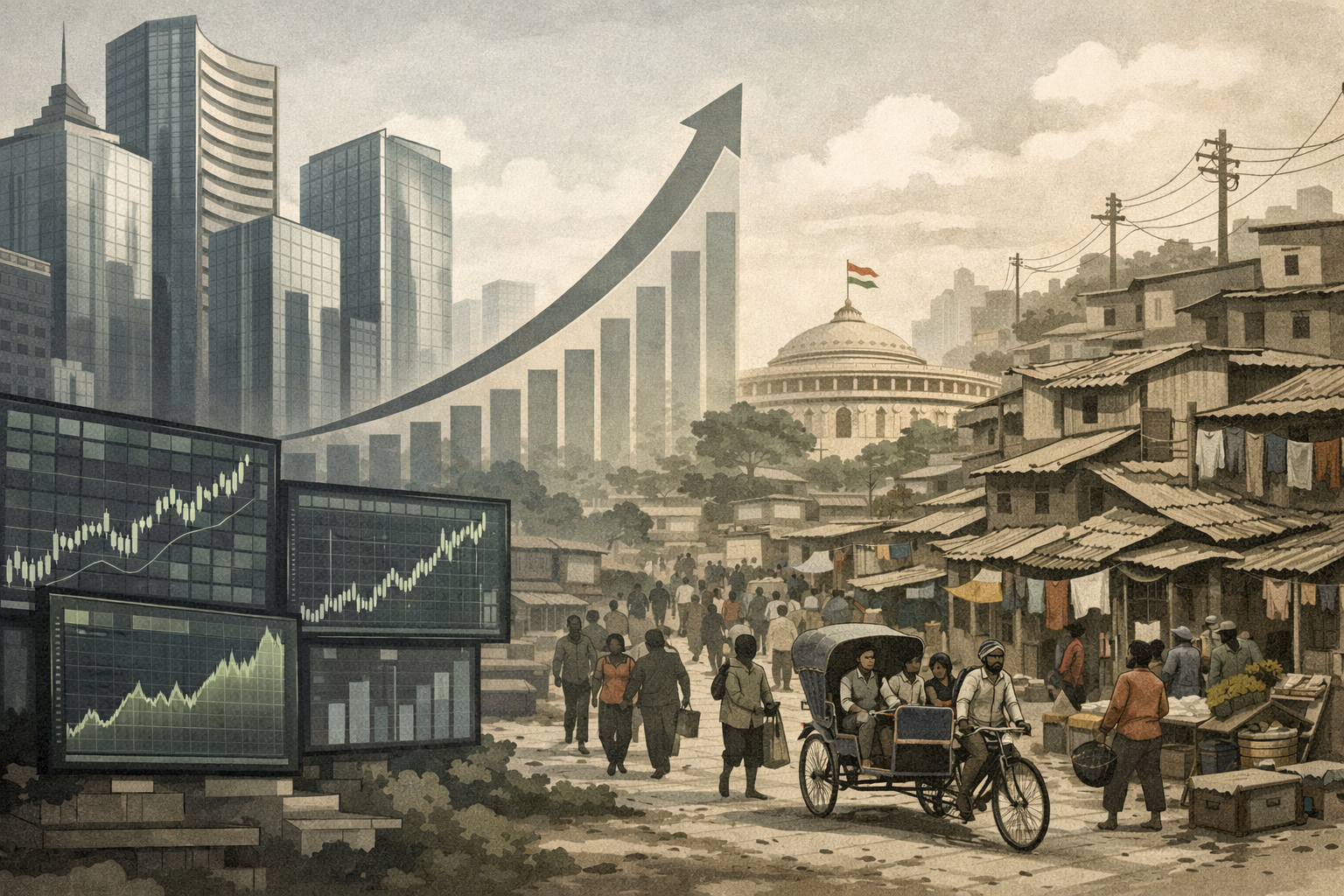
India heads into 2026 with headline indicators that would be the envy of many major economies.
Growth is strong, inflation is subdued, and political stability remains intact.
Yet beneath these reassuring numbers lies a widening disconnect between macro performance and lived economic reality, said a Financial Times report.
For investors and policymakers alike, this dichotomy will define the year ahead.
Growth accelerates, but gains remain uneven
India’s economy surprised on the upside in 2025.
Gross domestic product expanded 8.2% year on year in the July–September quarter, prompting the Reserve Bank of India to raise its growth forecast for 2026 to 6.8% from 6.5%.
Inflation has remained low for several quarters, giving the central bank room to consider further interest rate cuts this year.
However, this growth is being captured disproportionately by the affluent.
Property markets illustrate the imbalance clearly: ultra-luxury apartments priced above $1 million are snapped up within days of launch, while middle-income housing projects continue to carry unsold inventory for multiple quarters.
Value is rising, but volumes are not.
Two structural pressures are weighing on household wellbeing.
The first is employment. Official data shows unemployment falling to 4.7% in November 2025, yet recurring reports of hundreds of thousands of applicants chasing a few hundred or thousand public-sector jobs tell a different story.
In cities, gig work has absorbed many job seekers, but these roles often lack stability, safety nets, or upward mobility.
Meanwhile, part of the rise in employment figures reflects definitional changes that now count unpaid helpers in family enterprises as employed, particularly boosting women’s participation.
The second pressure point is household debt. According to RBI data, household liabilities exceeded 41% of GDP as of March 2025, with nearly half of borrowing directed toward consumption rather than asset creation.
Slower wage growth, job insecurity, and a savings rate still below pre-pandemic levels are forcing many households to borrow simply to maintain living standards.
The macro picture remains supportive, but the key risk for 2026 is that growth continues without translating into broader income and employment gains.
As a result, India may grow strongly this year while most wallets see limited relief.
Equity markets rise, portfolios lag
India’s equity markets mirror the broader economy’s imbalance.
Benchmark indices touched new highs in 2025, yet gains were concentrated in a narrow group of stocks.
Small and mid-cap shares struggled, with nearly half delivering negative returns and most others trading in a tight range.
For many retail investors, portfolios failed to reflect the headline index performance.
Outlook for 2026 is cautiously optimistic, but hinges on corporate earnings and liquidity conditions.
A potential US Federal Reserve rate cut could improve global risk appetite, but the link between lower US rates and foreign inflows into India has weakened.
Even after the US rate cuts last year, foreign portfolio investors continued to withdraw funds.
Domestically focused companies will depend on a revival in private-sector capital expenditure and consumption.
The technology sector could benefit if trade ties with the US stabilise, particularly around issues such as H1B visas, even though services are not currently subject to tariffs.
Primary markets were a major driver of activity in 2025, and IPO enthusiasm is expected to continue.
The anticipated listing of Reliance Jio in the first half of the year stands out as a potential landmark transaction.
Another near-term catalyst will be Finance Minister Nirmala Sitharaman’s annual budget speech, typically delivered in early February, where expectations are tempered by the limited fiscal headroom available.
Political stability, with emerging frictions
Politically, Prime Minister Narendra Modi’s government enters 2026 from a position of relative comfort.
State elections in Assam, Kerala, Tamil Nadu, and West Bengal are not seen as decisive for the ruling Bharatiya Janata Party at the national level.
Assam appears secure, while the southern states remain difficult terrain.
West Bengal is expected to be the most competitive contest.
This electoral breathing room gives the government scope to pursue difficult or unpopular measures.
At the same time, after more than a decade in power, the BJP-led administration is facing greater scrutiny.
Criticism has become more audible in mainstream media and on social platforms, including from outlets previously seen as firmly pro-government.
Recent pushback against expanded mining permissions in the Aravalli range showed this shift.
The opposition remains fragmented and has struggled in recent state elections, leaving Modi’s main challenges internal rather than external.
Questions around succession ahead of the 2029 general election linger, even as his electoral base remains stable.
For 2026, the key issue is how effectively the government uses political stability to address economic stress without triggering backlash.
While definitive answers may not emerge this year, the policy choices made now will likely shape the narrative heading into the next national election cycle.
The post India’s economy looks strong with low inflation—but do people feel it appeared first on Invezz